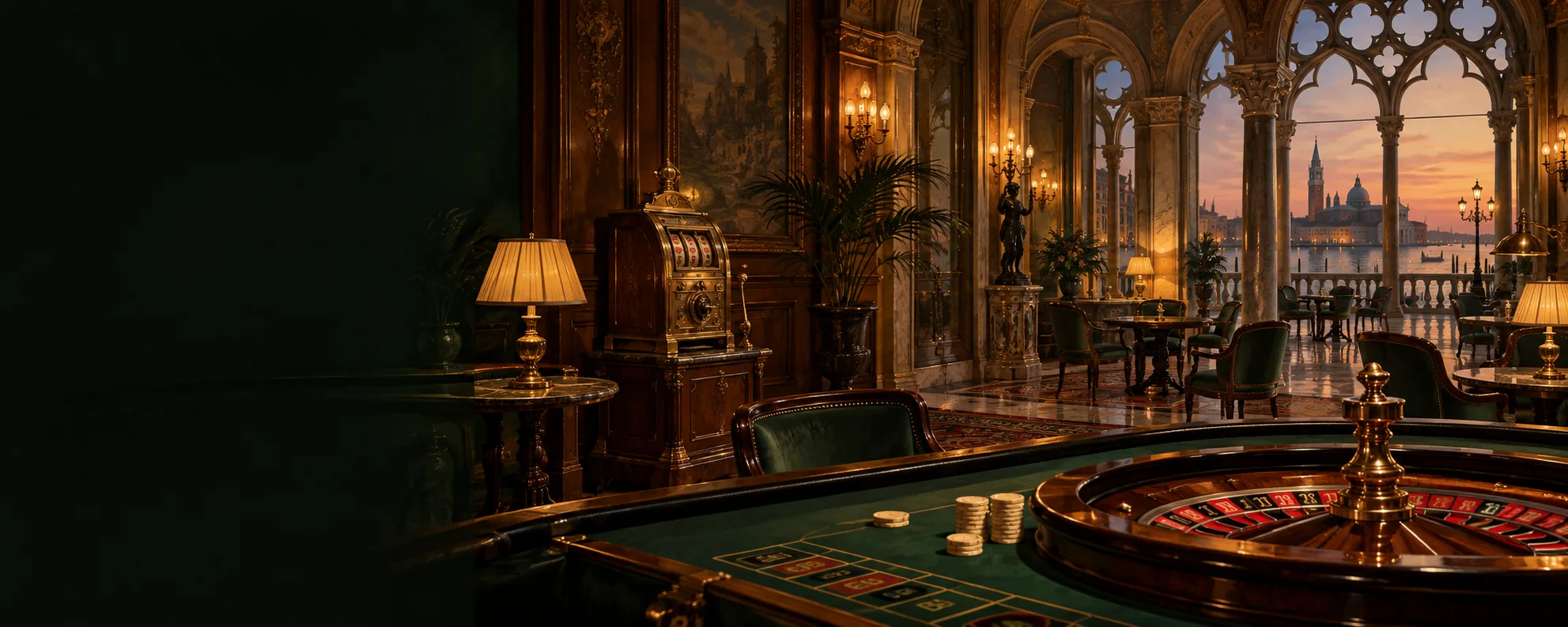
A guided history of the venues that changed the image, scale and geography of the casino. This article follows the evidence behind the familiar image and considers what changed for institutions, workers and visitors.
Venice: a long institutional memory
Casinò di Venezia connects its origins to 1638. Its importance is not simply age: Venice shows how a city could bring gaming into a defined institution. The modern venue is different from the seventeenth-century room, so “oldest” should be read as a claim of institutional lineage rather than an unchanged building or unchanged rulebook.
Monte Carlo: gaming as destination
The Casino de Monte-Carlo and the Société des Bains de Mer developed from 1863. Here the casino was planned within a luxury resort economy. Architecture, hospitality and gaming reinforced one another. The monumental approach and richly decorated rooms turned a visit into a social occasion, shaping a model copied by later resorts.
Monte Carlo also reminds us that casinos are political institutions. Privilege to operate, local law and the principality’s economic strategy were central to the venue’s success. The public image of effortless glamour rested on management, investment and regulation.
Las Vegas: spectacle and scale
Nevada’s modern legal gaming era began in 1931, according to its Gaming Control Board. Las Vegas then developed a distinct roadside and resort language. Hotels, casinos and entertainment were marketed together. Neon signs made properties visible from a moving car; themed interiors made each resort immediately recognisable.
The Stardust, opened in 1958, used a space-age identity that the Neon Museum documents through surviving signs. Its story shows how a casino could become a visual landmark as well as a gambling venue. Later large resorts expanded that logic with major entertainment programmes, convention space and integrated hospitality.
Helsinki: a Finnish reference point
Casino Helsinki is a useful counterpoint to the global resort story. Veikkaus reported that Finland’s first casino turned 30 in 2021, placing its opening in 1991. Its role developed within Finland’s distinctive gambling system, where public policy and harm prevention are central to the discussion. Veikkaus reported compulsory authentication at its casino games in 2021.
The venue illustrates why a “world casino history” cannot be told only through Las Vegas and Monaco. National rules, urban setting and public expectations create different forms of casino culture.
How to compare landmarks
The most useful comparison is not a ranking by size or luxury. Ask what each place introduced or made visible: public oversight in Venice, destination planning in Monte Carlo, mass spectacle in Las Vegas and a distinct regulatory context in Finland. Buildings change, and claims of “first” often depend on definitions; the underlying institutions are the more durable subject.
What makes a venue a landmark?
A landmark is more than a large gaming floor. It may introduce a recognisable business model, alter a city’s silhouette, become a reference point for architecture or embody a national policy choice. Physical survival is not required: a demolished resort can still influence later design. For this archive, a venue matters when evidence shows a wider effect on how casinos were organised, represented or governed.
This test also avoids an unhelpful “best casino” ranking. Visitor experience is subjective and changes quickly, while a documented historical contribution can be discussed and compared.
The nineteenth-century social club
Crockford’s Club, founded in London in 1828, represents a different landmark tradition from the open resort. Its name is associated with private membership, social status and high-stakes play rather than mass tourism. The current Crockfords brand is a later commercial lineage; its history should not be confused with a continuously unchanged room or rulebook. The distinction illustrates how clubs could become symbols even when their institutions transformed.
Club history is often told through famous patrons. Staff, credit practices and admission criteria are equally important, because they show how exclusivity was produced in daily operation.
The resort becomes an urban icon
The Venetian Resort Las Vegas opened in 1999, according to Las Vegas Sands, combining a large hotel with convention, shopping and entertainment space. The company later opened The Venetian Macao in 2007. These properties show how a casino can become one part of a much larger built environment. Their importance lies in the integrated model and the shift of attention from a single gambling room to an entire destination.
Marina Bay Sands, inaugurated in Singapore in 2010, made the integrated resort visible at city scale. Its architecture became a skyline marker even for people who never entered a gaming area. A landmark casino can therefore influence civic identity as well as leisure.
Different laws, different landmarks
The same design could not simply be copied across borders. A venue’s scale, games, age controls and advertising depend on local law. Casino Helsinki belongs in a global survey because it reflects a Finnish system of public supervision and harm prevention rather than the resort logic of Nevada or Macao. Veikkaus’s annual report records compulsory authentication at the casino in 2021, making the property a useful case for studying operational policy.
A comparative history should keep those differences visible. The buildings are memorable, but the permissions and responsibilities behind them are part of what each one represents.
How evidence can challenge a famous image
Promotional images usually show a venue at its most flattering: a polished façade, a quiet table or a celebrity guest. Annual reports, rules, photographs taken across decades and municipal records may show a more complex history of renovation, labour and ownership. A venue can be architecturally important while also reflecting exclusion or financial difficulty.
The Neon Museum’s preserved signs, for example, give material evidence of Las Vegas design, but their interpretation depends on dates and the properties to which they belonged. A landmark is best studied through several kinds of evidence rather than through a single famous photograph.
A route through the global story
Venice offers an early institutional claim; Monte Carlo shows the nineteenth-century resort; Nevada demonstrates legalisation and mass entertainment; Helsinki shows a nationally distinctive public-policy setting; Macao and Singapore illustrate the integrated resort at urban scale. Read in that order, the places reveal changes in audience, building size and the state’s role.
This is not a sequence in which one model simply replaced another. Private clubs, city casinos and destination resorts continue to coexist. The value of comparing them is to see how geography and law shaped different answers to the same organisational problem.
FURTHER READING
Sources & context
These primary and institutional sources support the dated claims above. They provide further context for readers who want to examine the historical record.
- Casinò di Venezia — official site
- Monte-Carlo Société des Bains de Mer — historical material
- The Neon Museum — history of the Las Vegas Strip
- Veikkaus — Annual and Sustainability Report 2021
- Resorts World Genting — Crockfords brand history
- Las Vegas Sands — company history
- Marina Bay Sands — company information
External links are for research, not operator recommendations.