From regulated rooms in Venice to the public casino: how gambling moved from private gatherings into controlled civic spaces. This article follows the evidence behind the familiar image and considers what changed for institutions, workers and visitors.
Before the casino had a name
Games of chance long predate the casino. Dice, cards and wagering moved through domestic rooms, taverns, fairs and courtly entertainments. A modern casino, however, is more specific: a dedicated place in which games are organised, access is managed and the operator is accountable for the premises. That distinction matters because a history of gambling is much older than a history of gambling houses.
In early modern Europe, authorities alternated between prohibition, toleration and tightly bounded permission. A controlled venue could be easier to supervise than scattered private play. It could also collect revenue. These practical motives help explain why the casino emerged alongside urban administration, tourism and elite leisure rather than as a simple invention of one game.
Venice and the Ridotto, 1638
Casinò di Venezia dates its institution to 1638 and describes itself as the oldest gaming establishment in the world. The commonly cited Ridotto was a public gaming room associated with Venice’s carnival season. Its significance lies in formal access and public oversight: gaming was placed in a recognisable venue and subject to rules, although the social world around it remained highly unequal.
The word “casino” originally referred to a small house or social room in Italian usage. It did not always mean a gambling business. The Venetian example therefore marks a transition in the organisation of play, not a neat point at which every modern casino feature suddenly appeared.
Spa towns, salons and the resort model
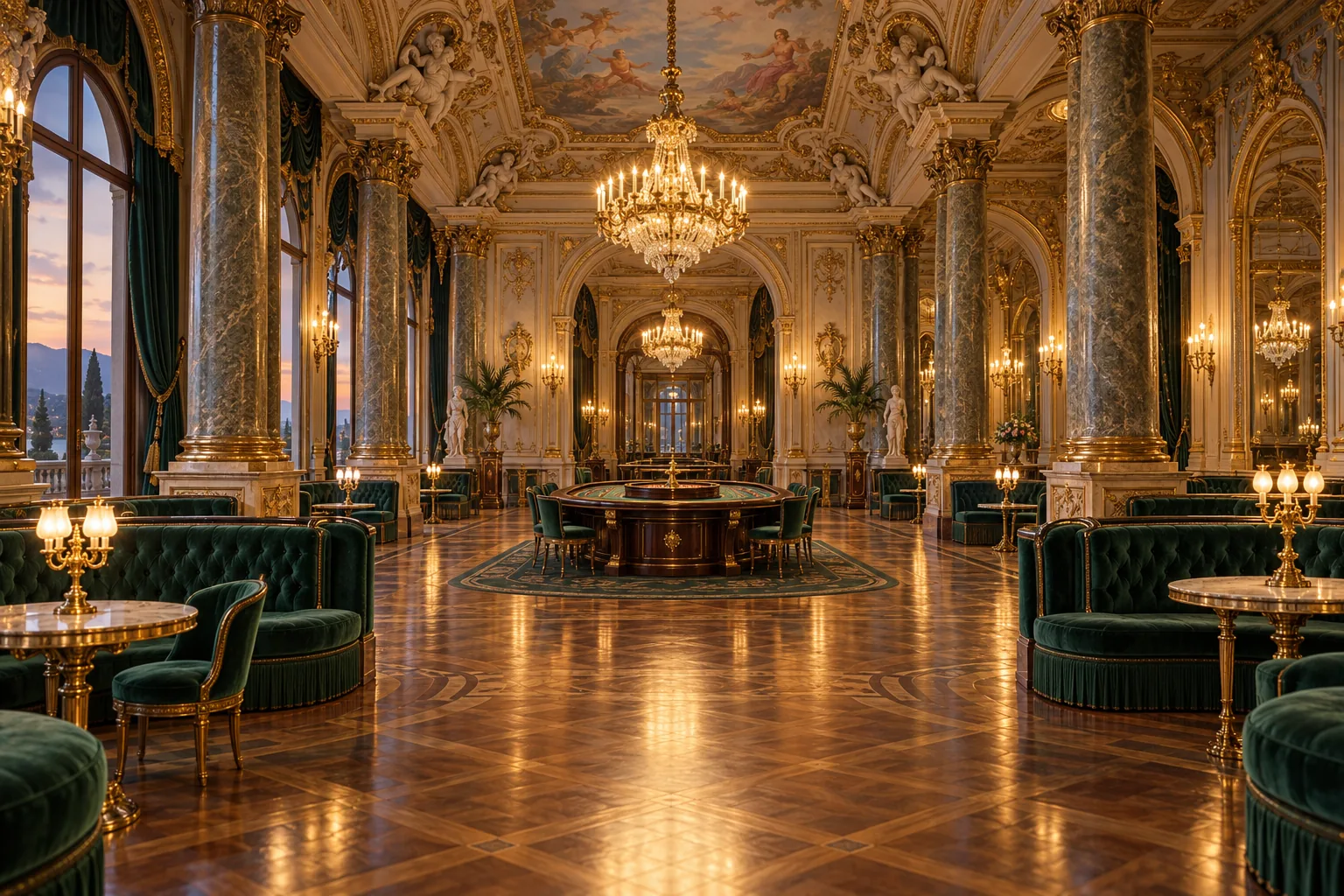
During the eighteenth and nineteenth centuries, European gaming rooms became part of a wider visitor economy. Spa towns brought together travel, lodging, music, dining and social display. A casino could serve as a gathering place whose architecture and etiquette carried as much meaning as the tables themselves.
Monte Carlo became the clearest nineteenth-century expression of this model. The Société des Bains de Mer traces its resort history to 1863. Gaming helped finance a destination with hotels, gardens, performance spaces and carefully managed public image. The idea of the casino as one element of a complete resort would later travel far beyond Europe.
What early houses established
The lasting innovation was institutional. Admission, opening hours, staff roles, game rules, accounting and oversight made play legible to operators and authorities. Later casinos changed the scale, technology and audience, but they inherited this basic framework: a designed space in which chance is presented through a controlled service.
Historical accounts often romanticise early casinos as glamorous rooms. They also reflected class boundaries and the state’s changing willingness to profit from, restrict or prohibit gambling. Both sides belong in the story.
Who controlled the threshold?
The word public can mislead when applied to early gaming houses. A room might be open beyond one private household yet still require money, status, appropriate dress and knowledge of social etiquette. Rules about admission were part of the institution. They determined whose losses and winnings were visible, whose conduct could be monitored and whose presence was considered respectable. A serious history of the casino must therefore ask who was absent from the surviving images as well as who appears in them.
The people who ran the room also deserve attention. Attendants prepared equipment, collected payments, settled disputes and kept the place functioning. Their work is less visible in the painted salon than a player at a table, but it is the practical difference between an informal gathering and an organised gaming establishment.
Permission, revenue and public order
A government might permit gaming in a designated place because supervised activity was easier to locate than scattered play. Permission could generate rent, fees or tax revenue, but it also created a duty to police disputes and limit disorder. When authorities changed their view, the same activity could be restricted again. The history of a gaming house is consequently inseparable from the legal documents that allowed it to operate.
Modern readers should be wary of treating permission as proof that a room was safe or fair by present standards. Seventeenth-century officials worked with different ideas of consumer protection. The useful historical question is what forms of oversight existed at a given date, whom they protected and which risks they ignored.
From gaming room to resort network
As leisure travel expanded, a gaming room could draw visitors who also needed transport, accommodation, meals and entertainment. The nineteenth-century resort connected those services into a destination. Monte Carlo is an important example because the operator’s history begins in 1863 and the casino became inseparable from the image of the principality. Architecture and hospitality changed the social meaning of a visit: the trip itself became part of the product.
That development did not replace the smaller gaming house everywhere. Different local laws and economies produced clubs, municipal casinos, hotel casinos and large resorts at the same time. There is no single straight line from Venice to every casino operating today.
How historians reconstruct an early house
An institution may claim a founding date while its current building, games or management come from later periods. Researchers compare charters, municipal orders, account books, travel writing, plans and surviving objects. Each source has limits. A travel diary can describe atmosphere but may repeat gossip; a licence can prove permission without showing how people actually behaved inside.
This is why Solvaretique treats the Venetian 1638 date as an institutional origin claim and explains the distinction between a historical Ridotto and the present venue. The difference makes the account more useful, not less impressive.
A practical glossary of early venues
A private salon was a social setting hosted by an individual or household. A gaming house was a place where organised play was a principal activity. A club added membership rules and recurring social ties. A resort casino joined the gaming room to travel, lodging and other entertainment. These are analytical categories rather than universal legal definitions: historical records use local words differently, and the same building could change function over time.
When reading a source, identify the institution behind the label. Who owned the room? Was entry restricted? Who set and enforced rules? Were fees or taxes paid? Answers to those questions reveal more than the word casino alone.
A chronology with limits
The Venetian institution dates its origin to 1638; Monte Carlo’s resort operator dates its beginning to 1863. These anchor points are useful precisely because they are documented by the institutions themselves. They should not be read as proof that gaming was invented in either city. Games and wagering had long existed in other social settings.
The historical change between those dates is the widening role of organised leisure travel. The gaming room became connected to hotel management, performance, dining and place branding. That connection would later help make the casino a recognisable destination across very different legal systems.
FURTHER READING
Sources & context
These primary and institutional sources support the dated claims above. They provide further context for readers who want to examine the historical record.
External links are for research, not operator recommendations.